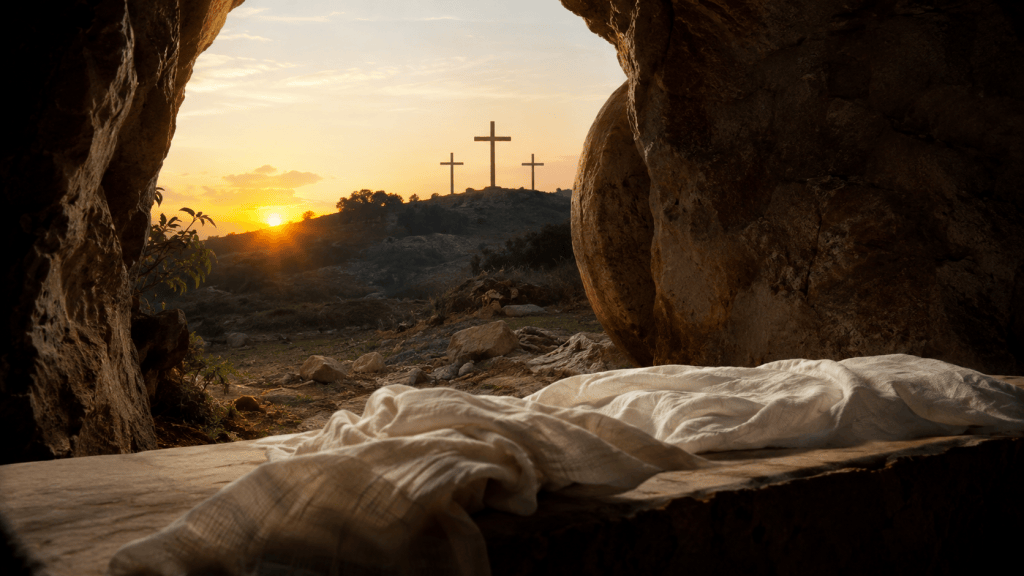
The Cross, the Empty Tomb, and the God Who Came Looking for Us
Throughout history, mankind has searched for answers to some of life’s greatest questions. Why are we here? Is there a God? What happens when we die? And perhaps the greatest question of all: How can we have a relationship with God?
Across the world, religions have attempted to answer these questions through teachings about morality, obedience, spiritual enlightenment, and religious practices. While there are many differences among these beliefs, Christianity makes one extraordinary claim that sets it apart. God did not simply give humanity another religious system to follow. He came to humanity through Jesus Christ to provide the salvation we could never accomplish on our own.
This is what makes faith in Jesus Christ so remarkable. Christianity is not about how good we can become to earn God’s acceptance. It is about what God has already done for us through His Son.
God Came Looking for Us
One of the greatest distinctions of Christianity is the identity of Jesus Christ. The Bible does not describe Him as merely a prophet, teacher, or religious leader. Scripture identifies Him as God who came in the flesh.
John 1:1 (KJV) declares, “In the beginning was the Word, and the Word was with God, and the Word was God.”
Then John 1:14 tells us, “And the Word was made flesh, and dwelt among us.”
Think about that for a moment. The Creator of the universe entered His own creation. The One who possessed all authority humbled Himself, walked among ordinary people, experienced suffering, and ultimately gave His life for humanity. Philippians 2:7–8 describes how Christ took the form of a servant and became obedient unto death, even the death of the cross.
Christianity teaches something extraordinary. God did not wait for humanity to find its way to Him. He made a way for humanity to come to Him.
Salvation Is Not Something We Can Earn
We live in a world where almost everything must be earned. We work for our wages, strive for promotions, and measure success by accomplishments. Unfortunately, many people approach God with that same mentality. They believe that if they can simply do enough good things, their good deeds will outweigh their failures.
But Scripture teaches something different.
Ephesians 2:8–9 (KJV) states, “For by grace are ye saved through faith; and that not of yourselves: it is the gift of God: Not of works, lest any man should boast.”
Romans 3:23 reminds us that all have sinned and fallen short of God’s glory. Yet Romans 5:8 gives us the incredible news that Christ died for us while we were still sinners.
Other religions also teach mercy, compassion, and forgiveness, and we should recognize that. However, the distinctive Christian message is that salvation comes through the completed work of Jesus Christ and is received by grace through faith, not earned through human achievement.
We do not perform good works to purchase God’s love. We do good works because we have experienced His love.
That is the beauty of grace.
The Cross and the Empty Tomb Change Everything
The central message of Christianity is not simply that Jesus lived a good life or taught great moral principles. It is that He died for our sins and rose again.
Hundreds of years before Christ, Isaiah wrote about the suffering servant. Isaiah 53:5 (KJV) declares, “But he was wounded for our transgressions, he was bruised for our iniquities: the chastisement of our peace was upon him; and with his stripes we are healed.”
Christians understand this prophecy as pointing toward the sacrifice of Jesus Christ. At the cross, we see both the seriousness of sin and the extraordinary mercy of God.
But Christianity does not end with a crucified Savior. It proclaims a risen Savior.
1 Corinthians 15:14 (KJV) states, “And if Christ be not risen, then is our preaching vain, and your faith is also vain.”
Think about what the Apostle Paul is saying. Christianity stands or falls on the resurrection of Jesus Christ. Without it, the Christian message loses its very foundation.
In 1 Corinthians 15:3–8, Paul records the early Christian testimony that Jesus died, was buried, rose again on the third day, and appeared to Peter, the apostles, more than five hundred people at once, and eventually Paul himself.
Many biblical scholars recognize that Paul was passing along an early Christian tradition, demonstrating that belief in the resurrection was present in the earliest generations of Christianity. This is historical evidence of what the first Christians proclaimed, although the resurrection itself remains a matter of historical debate and faith.
The cross demonstrates the price of our redemption. The empty tomb proclaims the Christian hope that death has been defeated.
What Does History and Archaeology Tell Us?
Some people dismiss Christianity as nothing more than religious tradition. However, the historical existence of Jesus is supported by sources beyond the Bible.
The Roman historian Tacitus, writing in the early second century in Annals 15.44, recorded that Christus was executed under Pontius Pilate during the reign of Emperor Tiberius. Tacitus was not a Christian supporter, making his account particularly significant as an independent historical reference.
The first-century Jewish historian Flavius Josephus, in Antiquities of the Jews, Book 20, referred to James as the brother of Jesus, who was called Christ. Most scholars consider this reference authentic.
Archaeology also provides fascinating connections to the New Testament world. In 1961, an inscription discovered at Caesarea Maritima confirmed the existence and official title of Pontius Pilate, the Roman governor associated with Jesus’ crucifixion.
Excavations in Jerusalem have also revealed the ancient Pool of Bethesda, whose layout corresponds with the description of five porches found in John 5:2. Additionally, a burial box discovered in Jerusalem in 1990 bears the name Joseph son of Caiaphas, possibly connecting it to the family of the high priest mentioned in the Gospels, although that identification is not certain.
These discoveries do not scientifically prove that Jesus performed miracles or rose from the dead. What they demonstrate is that the New Testament describes a recognizable historical world, including real locations, officials, and institutions.
Christianity is not presented in Scripture as a collection of timeless ideas alone. It is centered on events the earliest Christians believed actually happened in history.
Jesus Offers More Than Religion. He Offers New Life.
Perhaps one of the greatest misunderstandings about Christianity is that it is simply another set of rules to follow. Certainly, Scripture teaches obedience, holiness, and righteous living. But Christianity teaches that these things flow from a transformed heart, not merely outward religious performance.
2 Corinthians 5:17 (KJV) declares, “Therefore if any man be in Christ, he is a new creature: old things are passed away; behold, all things are become new.”
Jesus did not come simply to improve our behavior. He came to reconcile us to God and give us new life.
This is why Christianity offers hope to the broken, forgiveness to the guilty, and restoration to those who have fallen. It is not because Christians are somehow better than everyone else. We are not. It is because we serve a Savior who extends grace to sinners.
Jesus made an extraordinary declaration in John 14:6 (KJV): “I am the way, the truth, and the life: no man cometh unto the Father, but by me.”
That statement is exclusive concerning the way of salvation, but the invitation to receive it is open to everyone.
John 3:16 reminds us that God loved the world and gave His only begotten Son so that whoever believes in Him should not perish but have everlasting life.
The Question We Must All Answer
When we examine Christianity through Scripture, history, and archaeology, we discover a faith centered on an extraordinary claim: God entered human history through Jesus Christ, died for our sins, and rose again to offer eternal life.
The question is not whether Christians are better people than followers of other religions. History clearly demonstrates that Christians, like everyone else, are capable of failure. The question is whether Jesus Christ is who He claimed to be.
In Matthew 16:15, Jesus asked His disciples, “But whom say ye that I am?”
Peter answered in verse 16, “Thou art the Christ, the Son of the living God.”
That same question confronts every generation.
Who do you say Jesus is?
For me, the answer is found in the cross, the resurrection, and the grace of God. Christianity is not about celebrating how good we are. It is about proclaiming how good God has been to us through Jesus Christ.
The greatest difference is not what humanity can do for God, but what God has done for humanity through Jesus Christ.
And that is a truth worth building our lives upon.


Leave a Reply