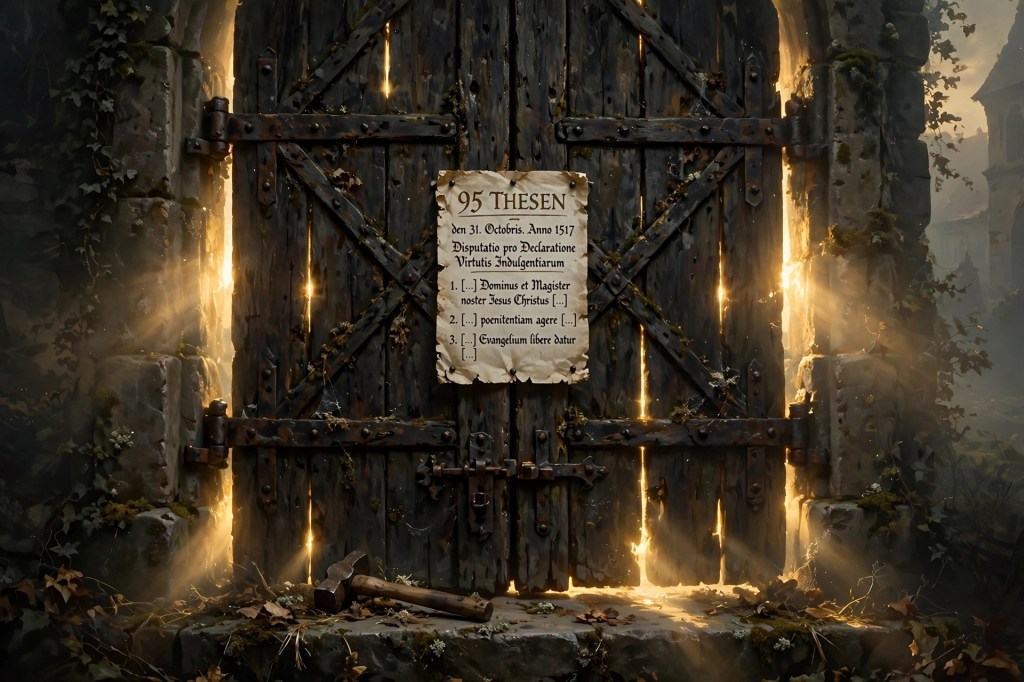
On October 31, 1517, a German monk named Martin Luther nailed 95 theses to the door of the Castle Church in Wittenberg. Most people remember the hammer and the door. But the revolution was in the very first line.
“When our Lord and Master Jesus Christ said ‘Repent,’ he willed the entire life of believers to be one of repentance.”
Read that again. The entire life. Not a moment at an altar. Not a prayer you pray once. Not a certificate you purchase. Your whole life, bent toward turning from sin and toward God.
What Luther Was Actually Fighting
Luther wasn’t picking a fight for the sake of it. A salesman named Johann Tetzel was traveling through Germany selling indulgences — literally selling forgiveness. His pitch line became infamous: “As soon as the coin in the coffer rings, the soul from purgatory springs.” Pay money, skip punishment. Forgiveness had a price tag.
Luther looked at that and said no. Not because he hated the Church — in 1517 he was still a loyal monk trying to reform it from the inside. He said no because the Gospel doesn’t work that way. The Pope cannot remit guilt, he argued. Only God can. And God’s forgiveness was never for sale.
Thesis 62 puts it plainly: “The true treasure of the church is the most holy gospel of the glory and grace of God.” Not a treasury of merits. Not coins in a coffer. The Gospel.
Romans 6: The Biblical Engine
Here’s what makes Luther’s first thesis so powerful — he wasn’t inventing anything. He was rediscovering what Paul had written 1,400 years earlier in Romans 6.
e-Sword
Rom 6:1 What should we say then? Should we continue to sin so that God’s kindness will increase?
Rom 6:2 That’s unthinkable! As far as sin is concerned, we have died. So how can we still live under sin’s influence?
Paul’s logic is devastating in its simplicity. In baptism, we were buried with Christ — and just as Christ was raised from the dead, “we too may live a new life” (Romans 6:4). Our old self was crucified. The person who owed the debt is dead. You don’t pay off a dead man’s bills, and you don’t buy forgiveness for a sin-debt that was nailed to a cross.
That’s why Paul can command: “Count yourselves dead to sin but alive to God in Christ Jesus” (Romans 6:11). Repentance isn’t a transaction you complete. It’s an identity you live in. Every day you wake up and reckon — count it true — that sin doesn’t own you anymore.
The Daily Dying
This is where Luther’s “entire life of repentance” and Paul’s “dead to sin” meet. Repentance isn’t groveling. It isn’t shame as a lifestyle. It’s the daily practice of agreeing with what God already declared: the old you died, the new you lives.
Some days that looks like saying no to the temper that used to run you. Some days it’s the quiet choice to forgive when you’d rather hold the grudge. Some days it’s just getting up and choosing God again when yesterday was a mess. That’s the life of repentance — not perfection, but direction.
Tetzel offered people a shortcut: pay and skip the hard part. But there is no shortcut, because there’s nothing to buy. “The wages of sin is death, but the gift of God is eternal life in Christ Jesus our Lord” (Romans 6:23). A wage is earned. A gift is received. You cannot purchase what was already free.
Thirty Years Ago
I first read Martin Luther’s theses more than thirty years ago, and his story inspired me. Here was a man who simply wanted to reform some bad and misinterpreted doctrine. That was it. No rebellion for rebellion’s sake — just a man who saw something wrong and couldn’t stay quiet about it.
What struck me then still holds me now: no man can forgive sins, and no money could buy forgiveness. It is freely given and freely received.
I think about today, and how we are in desperate need of reformation from some bad doctrine and religious dogma. The church still collects its own versions of indulgences — not coins in a coffer anymore, but the same old transaction dressed in new clothes. And the answer is the same as it was in 1517.
The reality is, the reformation starts at the heart first — and then spreads like fire to others. Martin Luther lived this truth. The question is whether we will.
The Question
Five hundred years later, we’re not buying indulgences from traveling salesmen. But the temptation is the same: we still look for the transaction. The donation that quiets the conscience. The good deed that balances the bad one. The performance that earns what was already free.
Luther’s first thesis still asks its question: is your repentance a moment you visit, or a life you live?


Leave a Reply