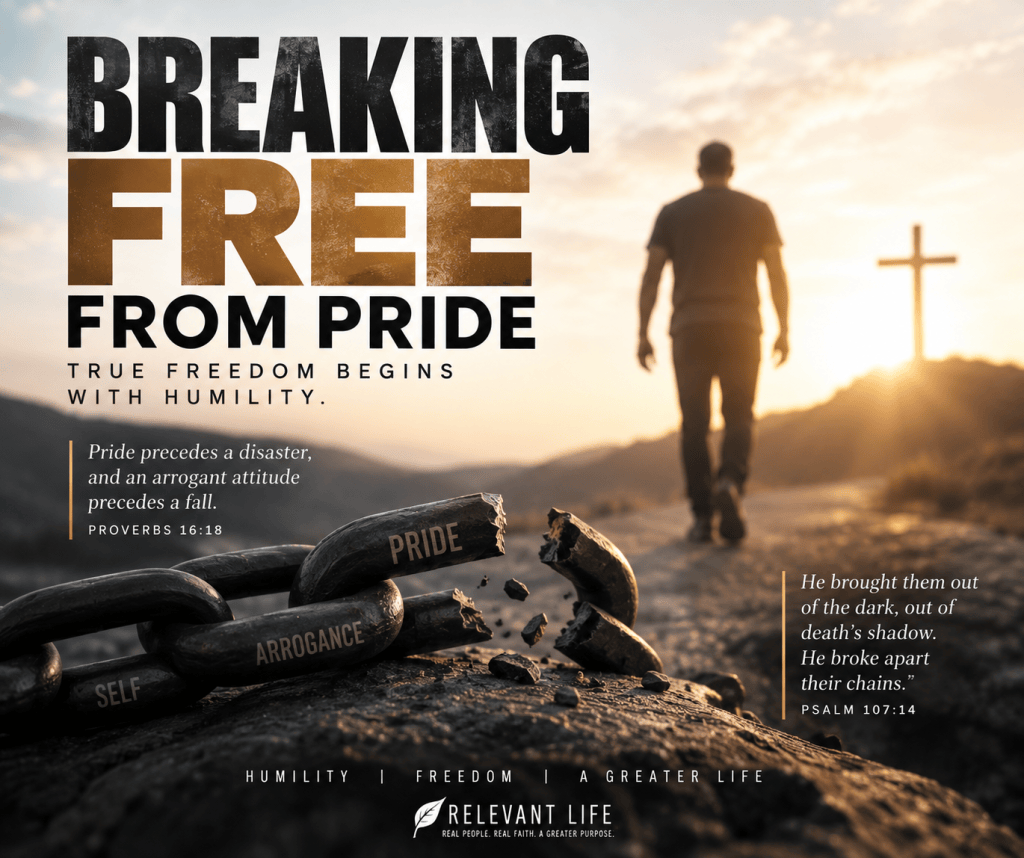
I have met some amazing people throughout my life. Some of them went on to serve God in incredible ways, while others remained bound by things they were never able—or sometimes never willing—to surrender.
It is always difficult to watch someone live in bondage. When you care about them, you find yourself wondering, What could I have done differently? Could I have said something more? Could I have helped them see what was happening?
We usually recognize bondage when we see addiction or destructive behavior. But there is another kind of bondage that can be much harder to recognize because it often hides behind confidence, success, morality, knowledge, religion, and even good works.
It is the bondage of pride.
C.S. Lewis wrote, “Pride leads to every other vice: it is the complete anti-God state of mind.”
Those are strong words, but they expose something important about pride. Pride doesn’t simply influence what we think about ourselves. Eventually, it can influence how we see God, other people, correction, truth, and even our need for a Savior.
The Invisible Chains of Pride
Pride is dangerous because the person bound by it may not realize they are bound.
Someone struggling with an obvious addiction may eventually recognize, “Something has control over me.” Pride can do the opposite. Pride whispers, You’re fine. You’re right. You don’t need help. Everyone else is the problem.
That is what makes pride such a dangerous form of bondage.
Proverbs gives us this warning:
Proverbs 16:18–19
“Pride precedes a disaster, and an arrogant attitude precedes a fall. Better to be humble with lowly people than to share stolen goods with arrogant people.”
Pride can put us on a road toward destruction while convincing us that we are traveling in the right direction.
Andrew Murray wrote, “Pride must die in you, or nothing of heaven can live in you.”
Humility isn’t thinking that we have no value. Biblical humility is recognizing that everything we are ultimately depends upon God.
Pride Says, “I Don’t Need God”
I understand this because I once believed the lie myself.
Before I surrendered my life to Christ, I was a 13-year-old boy who thought my own goodness was enough. I looked at my life and thought I was doing pretty well. I wasn’t living what I considered to be a terrible life, so in my young mind I wondered, Why do I need God?
I had convinced myself that because I was morally good, I didn’t need a Savior.
That was pride.
Then one night, the Holy Spirit convicted my heart.
Something changed in the way I saw myself. In my mind, it was almost as though my good works were written on one side of a whiteboard and the works of Christ were written on the other.
Suddenly, there was no comparison.
My goodness was often mixed with self-interest. Christ’s life was marked by perfect obedience, sacrifice, mercy, love, and ultimately the cross.
I realized something that night:
My righteousness could never compare with the righteousness of God.
No amount of pride could change that truth.
The Cross Leaves No Room for Boasting
Paul understood this deeply. Before encountering Christ, Paul had an impressive religious résumé. He had heritage, education, religious commitment, and zeal. Yet after meeting Christ, his perspective completely changed.
Paul writes in Philippians 3:7–9:
“However, what things were gain to me, these have I counted loss for Christ. Yes most certainly, and I count all things to be loss for the excellency of the knowledge of Christ Jesus, my Lord, for whom I suffered the loss of all things, and count them nothing but refuse, that I may gain Christ and be found in him, not having a righteousness of my own, that which is of the law, but that which is through faith in Christ, the righteousness which is from God by faith.”
Paul discovered what every one of us eventually must discover.
We cannot save ourselves.
Our accomplishments cannot save us. Our reputation cannot save us. Our morality cannot save us. Our religious activity cannot save us. We need Jesus.
Charles Spurgeon said, “Humility is to make a right estimate of oneself.”
When we truly see Christ, we begin seeing ourselves differently.
Pride Can Make Chains Feel Normal
One of the most frightening things about bondage is that eventually the chains can begin to feel normal. Imagine carrying something heavy every day. At first, you notice the weight. After enough time, you begin adjusting your life around it. Pride can work the same way. It can separate families because neither person will apologize. It can destroy friendships because someone refuses to admit they were wrong. It can damage marriages because winning the argument becomes more important than loving the person. It can destroy teams because leaders become incapable of receiving correction. It can damage churches because people become more concerned with position and recognition than serving Christ.
Pride creates an illusion of strength while quietly producing weakness.
It tells us, Don’t apologize.
Don’t admit you were wrong.
Don’t ask for help.
Don’t forgive.
Don’t listen.
Don’t surrender.
Eventually, those chains become so familiar that we begin believing they are simply part of who we are. But they don’t have to be.
Pride Sets Our Minds on Ourselves
Paul gives another serious warning:
Philippians 3:19–20
“whose end is destruction, whose god is the belly, and whose glory is in their shame, who think about earthly things. For our citizenship is in heaven, from where we also wait for a Savior, the Lord Jesus Christ.”
Pride turns our attention inward. It makes life about my desires, my reputation, my accomplishments, my opinions, my rights, my recognition and my way.
Jesus calls us toward something radically different.
He calls us to surrender.
He calls us to serve.
He calls us to love.
He calls us to humility.
He calls us to take up our cross and follow Him.
Jesus Modeled the Opposite of Pride
If pride says, “Make everything about yourself,” Jesus demonstrated the exact opposite.
Philippians 2:5–8 tells us:
“Have this in your mind, which was also in Christ Jesus, who, existing in the form of God, didn’t consider equality with God a thing to be grasped, but emptied himself, taking the form of a servant, being made in the likeness of men. And being found in human form, he humbled himself, becoming obedient to death, yes, the death of the cross.”
Think about that. Jesus had every reason to exalt Himself, yet He humbled Himself. He served. He washed feet. He touched people others rejected. He welcomed children. He showed compassion to sinners. And ultimately, He went to the cross.
Jesus said in Matthew 20:28:
“Even as the Son of Man came not to be served, but to serve, and to give his life as a ransom for many.”
The cure for pride isn’t simply thinking less of ourselves.
It is becoming more consumed with Christ and learning to serve others.
The Chain Breaker
Here is the good news: bondage does not have to be permanent.
Psalm 107 gives us a beautiful picture of God’s deliverance:
Psalm 107:13–15
“Then they cried to Yahweh in their trouble, and he saved them out of their distresses. He brought them out of darkness and the shadow of death, and broke away their chains. Let them praise Yahweh for his loving kindness, for his wonderful deeds to the children of men!”
I love those words:
“He broke away their chains.”
There are chains you may not be able to break through willpower alone. There are patterns that have become deeply embedded in your thinking. There are attitudes you may have carried for years.
Jesus came to bring freedom.
Jesus Came to Set People Free
Jesus announced His mission in Luke 4:18–19:
“The Spirit of the Lord is on me, because he has anointed me to preach good news to the poor. He has sent me to heal the broken hearted, to proclaim release to the captives, recovering of sight to the blind, to deliver those who are crushed, and to proclaim the acceptable year of the Lord.”
Jesus came to free people. He frees us from sin. He frees us from condemnation. He frees us from our attempts to establish our own righteousness before God. And He can free us from pride. But freedom requires something pride hates:
Surrender.
Six Ways to Begin Breaking Free From Pride
1. Allow the Holy Spirit to Humble You
Ask God to reveal areas of pride you cannot see yourself. This isn’t always comfortable, but freedom often begins when God shows us something we have refused to see.
David prayed in Psalm 139:23–24:
“Search me, God, and know my heart. Try me, and know my thoughts. See if there is any wicked way in me, and lead me in the everlasting way.”
That is a dangerous prayer for pride—but a powerful prayer for freedom.
2. Compare Your Goodness With Christ, Not Other People
Try the exercise that became so real to me when I was 13.
Imagine a whiteboard. On one side, write your greatest accomplishments and good deeds. On the other, consider Jesus: His holiness, His compassion, His obedience, His sacrifice, and His cross.
The comparison changes everything.
Pride grows when we compare ourselves with people we believe are beneath us. Humility grows when we look toward Christ.
3. Surrender Your Self-Righteousness
Stop trying to convince God—or yourself—that you can earn righteousness.
Grace begins where self-righteousness ends.
Ephesians 2:8–9 says:
“For by grace you have been saved through faith, and that not of yourselves; it is the gift of God, not of works, that no one would boast.”
Notice those final words: “that no one would boast.”
The Gospel leaves no room for spiritual pride.
4. Run From the Old Nature
Don’t continually feed the attitudes you are asking God to remove.
Practice saying, “I was wrong.” Practice apologizing. Listen before responding. Serve when nobody is watching. Celebrate someone else’s success. Forgive without demanding recognition.
Pride grows when everything revolves around us. Humility grows when Christ becomes the center.
5. Bury Yourself in Prayer and God’s Word
Pride grows when our own voice becomes the loudest voice in our lives.
Scripture corrects that. Prayer corrects that. God’s Word reminds us who God is and who we are. The more clearly we see His greatness, the less impressive our pride becomes.
6. Surround Yourself With Humble People
We need people who can tell us the truth.
Not people who constantly flatter us. Not people who agree with everything we say. We need mature believers who love us enough to challenge us when necessary.
Proverbs 27:17 says:
“Iron sharpens iron; so a man sharpens his friend’s countenance.”
Give trusted people permission to speak into your life.
Then have enough humility to listen.
Humility Is Freedom
Pride tells you surrender is weakness. Jesus shows us that surrender is where freedom begins. Pride says you must always prove yourself. Grace says Christ has already done what you could never do for yourself. Pride says you must always be right. Humility says you can learn. Pride says admitting failure makes you weak. Humility says admitting failure gives you the opportunity to grow. Pride says you don’t need anyone. God says we need Him and we need one another.
D.L. Moody once said, “Be humble, or you’ll stumble.”
Simple words. Powerful truth.
The Choice Is Ours
Pride can become a prison without visible walls. The chains may be invisible, but their effects can be seen in relationships, families, workplaces, churches, and individual lives.
But Jesus still breaks chains. Maybe the greatest obstacle isn’t whether Jesus can set us free. Maybe the question is whether we’re willing to admit that we need freedom. That was the lesson I had to learn as a 13-year-old boy. I thought my goodness was enough until Christ showed me something better than my goodness.
He showed me His grace.
And once you truly understand grace, there isn’t much room left for pride. So ask God to search your heart. Let Him expose what needs to change. Lay down your self-righteousness. Receive His grace. Learn to apologize. Learn to listen. Learn to serve. And when pride tells you that you don’t need to change, remember the warning of Proverbs:
“Pride precedes a disaster, and an arrogant attitude precedes a fall.”
You don’t have to continue carrying those chains.
Jesus came to set the captive free.
The question is: Are we humble enough to let Him?
— Relevant Life


Leave a Reply