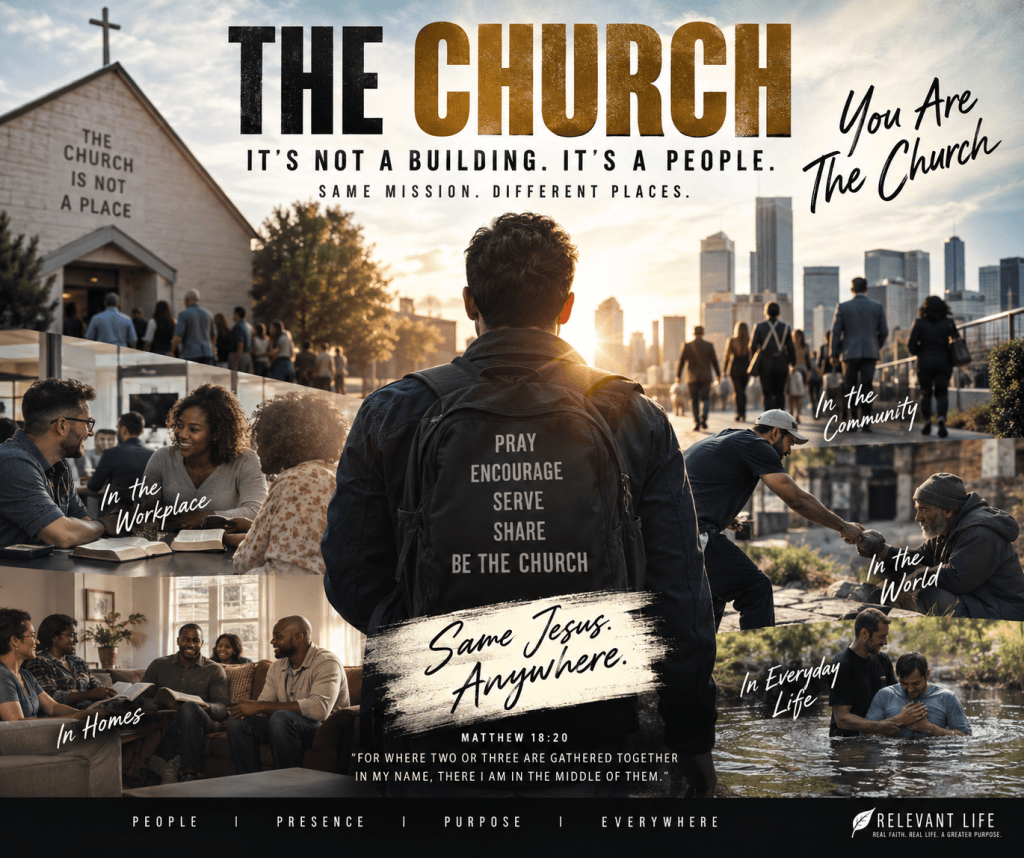
It may sound cliché, but it needs to be said: the Church is not a building. The Church is not brick, mortar, stained glass, a steeple, or a sign beside the highway. The Church is God’s people.
The Greek word commonly translated as “church” in the New Testament is ekklesia. It refers to an assembly or gathering of people. That changes how we should think about church. We don’t simply go to church. As followers of Jesus Christ, we are the Church.
Wherever believers gather around Jesus Christ—in homes, workplaces, public places, or designated church buildings—the people of God can function as the Church. Church was never intended to be something we turn on Sunday morning and turn off Sunday afternoon. The Church is alive. The Church moves. The Church serves. The Church loves. The Church witnesses. The Church carries Jesus into everyday life.
I Saw the Church in a Break Room
Years ago, while working for another company, I started a Bible group during our lunch breaks. We met right there in the break room. There was no sanctuary, pulpit, stained glass, worship team, or denominational name on the door.
Christians from several denominations participated. Each week I would pass the baton to another Christian who wanted to lead the discussion. Something beautiful happened. We experienced unity. We opened God’s Word, talked about Jesus, encouraged one another, and shared the Gospel with anyone willing to listen.
Several people came to Christ through what happened in that workplace. That was the Church. It didn’t need a steeple to become holy. God’s people were gathered, Christ was proclaimed, believers were encouraged, and lives were changed.
Jesus Builds His Church
Jesus made an incredible promise in Matthew 16:18 (WEB): “I also tell you that you are Peter, and on this rock I will build my assembly, and the gates of Hades will not prevail against it.”
Think about those words: “I will build my church.” Jesus is the builder. Jesus is the foundation. Jesus is the head. A carpenter’s son came into this world and began building something governments couldn’t destroy, persecution couldn’t eliminate, and even the gates of hell couldn’t overpower.
Jesus wasn’t primarily building buildings. He was building people.
Colossians 1:18 (WEB) says: “He is the head of the body, the assembly, who is the beginning, the firstborn from the dead, that in all things he might have the preeminence.”
Christ is the head, and believers are His body. A building isn’t the Body of Christ. People are.
Dietrich Bonhoeffer wrote, “Christianity means community through Jesus Christ and in Jesus Christ.” That is a beautiful picture of the Church: people brought together through Jesus Christ.
What Did the Early Church Look Like?
One of my favorite pictures of the Church is found in Acts 4.
Acts 4:32–37 (WEB)
“The multitude of those who believed were of one heart and soul. Not one of them claimed that anything of the things which he possessed was his own, but they had all things in common. With great power, the apostles gave their testimony of the resurrection of the Lord Jesus. Great grace was on them all. For neither was there among them any who lacked, for as many as were owners of lands or houses sold them and brought the proceeds of the things that were sold, and laid them at the apostles’ feet, and distribution was made to each, according as anyone had need. Joses, who by the apostles was also called Barnabas (which is, being interpreted, Son of Encouragement), a Levite, a man of Cyprus by race, having a field, sold it and brought the money and laid it at the apostles’ feet.”
There was the Church. Luke doesn’t focus on their building, sanctuary, sound system, programs, or denominational identity. He describes people living as the Body of Christ.
They were united. They shared what they had. They testified about the resurrection of Jesus. God’s grace was upon them. Needs were being met, and people willingly gave so others could be helped. They weren’t simply attending something. They were participating in something.
The Church Met From House to House
Acts gives us another picture of the early believers.
Acts 2:42–47 (WEB)
“They continued steadfastly in the apostles’ teaching and fellowship, in the breaking of bread, and prayer. Fear came on every soul, and many wonders and signs were done through the apostles. All who believed were together, and had all things in common. They sold their possessions and goods, and distributed them to all, according as anyone had need. Day by day, continuing steadfastly with one accord in the temple, and breaking bread at home, they took their food with gladness and singleness of heart, praising God and having favor with all the people. The Lord added to the assembly day by day those who were being saved.”
Notice that they gathered in the temple and in homes. The power wasn’t in the location. The power was Christ among His people.
Your Workplace Can Become a Place of Ministry
Matthew 18:20 (WEB) says: “For where two or three are gathered together in my name, there I am in the middle of them.”
Your workplace can become a place of ministry. Your home can become a place of ministry. A restaurant table can become a place of ministry. A hospital room can become a place of ministry. A break room can become a place of ministry. Even an old creek can become a baptismal pool.
I know because I have experienced it. I have had the privilege of baptizing believers whom I helped lead to the Lord at work—in an old creek in the middle of fall. I have also witnessed some of the greatest answers to prayer and what I believe were miraculous works of God outside a traditional church building.
God isn’t confined to our buildings.
The Building Should Serve the Church
This is not an attack on church buildings. Buildings can be tremendous tools for ministry. They give believers places to worship, teach, pray, disciple, feed people, counsel families, and serve their communities.
But there is a difference between using a building and allowing a building to define the Church. The building should serve the Church. The Church should never become a servant of the building.
When Christianity becomes primarily about maintaining buildings, budgets, programs, positions, and institutions, we should ask whether we have confused the container with the contents. The Church isn’t the structure. The Church is the people—and those people are still the Church when they walk outside.
Jesus Sent Us Into the World
John 17:15–18 (WEB) says: “I pray not that you would take them from the world, but that you would keep them from the evil one. They are not of the world, even as I am not of the world. Sanctify them in your truth. Your word is truth. As you sent me into the world, even so I have sent them into the world.”
Jesus didn’t pray that His followers would escape the world. He sent them into it. The Church cannot hide behind four walls. We have been sent into our neighborhoods, workplaces, communities, and world carrying the Gospel of Jesus Christ.
Charles Spurgeon said, “Every Christian is either a missionary or an impostor.” Those are strong words, but they make an important point. Following Jesus means taking His message beyond ourselves.
Ministry Isn’t Just for Professionals
Western Christianity has sometimes created the impression that “real ministry” primarily happens inside church institutions. That can create an artificial division between clergy and everyone else. But Scripture presents every believer as part of Christ’s Body.
Some people have also been taught that a pastor cannot work a regular job and still faithfully shepherd God’s people. Yet Paul worked.
Acts 18:2–3 (WEB) says: “He found a certain Jew named Aquila, a man of Pontus by race, who had recently come from Italy, with his wife Priscilla, because Claudius had commanded all the Jews to depart from Rome. He came to them, and because he practiced the same trade, he lived with them and worked, for by trade they were tent makers.”
Paul worked while carrying out ministry. That doesn’t mean every pastor must work another job. Scripture also supports ministers receiving support. It simply means working another job doesn’t disqualify someone from ministry. The issue isn’t whether someone receives a paycheck from a church. The issue is whether that person is obedient to God.
Pastors Are Shepherds
Pastors have an important place in the Body of Christ, but pastors don’t replace Jesus. Christ is the Head of the Church.
1 Peter 5:2–3 (WEB) says: “Shepherd the flock of God which is among you, exercising the oversight, not under compulsion, but voluntarily, not for dishonest gain, but willingly; neither as lording it over those entrusted to you, but making yourselves examples to the flock.”
That is biblical leadership. Not domination. Not celebrity. Not control. Shepherding. Pastors should lead through service, love, truth, sacrifice, and example.
Every Believer Has a Calling
1 Corinthians 12:12–14 (WEB) says: “For as the body is one, and has many members, and all the members of the body, being many, are one body; so also is Christ. For in one Spirit we were all baptized into one body, whether Jews or Greeks, whether bond or free; and were all given to drink into one Spirit. For the body is not one member, but many.”
Every believer matters. Your calling matters. Your spiritual gifts matter. Your workplace doesn’t cancel your calling.
If God has gifted you to evangelize, evangelize. If God has gifted you to teach, teach. If God has gifted you to encourage, encourage. If God has gifted you to give, give. If God has gifted you to lead, lead. If God has called you to shepherd, shepherd.
You don’t have to wait until you are standing behind a pulpit to become who God called you to be.
The Purpose Is to Equip the Body
Ephesians 4:11–13 (WEB) says: “He gave some to be apostles; and some, prophets; and some, evangelists; and some, shepherds and teachers; for the perfecting of the saints, to the work of serving, to the building up of the body of Christ; until we all attain to the unity of the faith and of the knowledge of the Son of God, to a full grown man, to the measure of the stature of the fullness of Christ.”
The purpose of these gifts is to equip God’s people for ministry. The goal isn’t to create spectators. The goal is to build up the Body of Christ.
Yes, Christians Should Gather
Saying the Church isn’t a building does not mean believers don’t need to gather together. We absolutely do.
Hebrews 10:24–25 (WEB) says: “Let us consider how to provoke one another to love and good works, not forsaking our own assembling together, as the custom of some is, but exhorting one another; and so much the more as you see the Day approaching.”
We need fellowship, teaching, encouragement, accountability, and prayer. We need brothers and sisters who will stand beside us when we are hurting and challenge us when we are wrong.
Scripture tells us to gather, but the gathering isn’t limited to one type of building. Gather in a sanctuary. Gather in a home. Gather in a break room. Gather around a kitchen table. Gather wherever God’s people can faithfully come together in Christ.
Just don’t leave Jesus inside the building when the meeting ends.
You Are the Church
1 Corinthians 12:27 (WEB) says: “Now you are the body of Christ, and members individually.”
You are part of the Body of Christ. So be the Church.
Be the Church when you walk into work Monday morning. Be the Church when your neighbor needs help. Be the Church when someone is hungry. Be the Church when someone needs prayer. Be the Church when someone needs encouragement. Be the Church when a coworker asks why you still have hope when everything around you seems hopeless.
Don’t just invite people to a building. Introduce them to Jesus.
Francis Schaeffer wrote, “Our relationship with each other is the criterion the world uses to judge whether our message is truthful.”
Imagine what could happen if believers recovered that vision. Instead of competing over church names and denominations, imagine believers united around Jesus Christ—loving one another, serving one another, meeting needs, preaching the Gospel, making disciples, and carrying Christ into everyday life.
That is a Church the world cannot ignore.
Stop Acting Like the Church and Be the Church
Yes, gather together. Yes, worship together. Yes, learn Scripture together. Yes, encourage one another. Yes, submit to healthy spiritual leadership.
But don’t become bound by the idea that the Church only exists at a particular address during particular hours.
Ask yourself: Am I being the Church to the world around me? Does my workplace see Jesus through me? Does my family? Do my neighbors? Do the hurting and forgotten?
What about the people who would never voluntarily walk through the doors of a church building?
They may never walk into your church building. But tomorrow morning, the Church may walk into their workplace. And that Church might be you.
Matthew 5:14–16 (WEB) says: “You are the light of the world. A city located on a hill can’t be hidden. Neither do you light a lamp and put it under a measuring basket, but on a stand; and it shines to all who are in the house. Even so, let your light shine before men, that they may see your good works and glorify your Father who is in heaven.”
Church, don’t hide the light. Don’t confine it to four walls. Don’t limit what God has placed inside you.
Take Jesus into your workplace. Take Jesus into your neighborhood. Take Jesus into your home. Take Jesus into your community. Take Jesus wherever God sends you.
Because the Church isn’t somewhere you go. In Christ, the Church is who we are together.
You are the Church. Now go be the Church.
— Relevant Life
 Relevant Life
Leave a comment